Frank Stella
Frank Stella was a pivotal figure in postwar American art, best known for his role in shaping Minimalism and for continually reinventing his practice over his career. Stella was born in Malden, Massachusetts in 1936 and he studied history at Princeton University, where he was influenced by art historian William Seitz and exposed to the work of Abstract Expressionists such as Jackson Pollock and Franz Kline. After graduating in 1958, he moved to New York City, where his early “Black Paintings” quickly gained attention for their stark geometry and rejection of illusionism. As Stella said, “What you see is what you see.” Over time, Stella expanded beyond painting into reliefs, sculpture, and monumental public works, consistently pushing the boundaries between abstraction, space, and form.
Stella’s work is held in the permanent collections of many of the world’s most important museums, including the Museum of Modern Art, the Metropolitan Museum of Art, the Whitney Museum of American Art, the Solomon R. Guggenheim Museum, and the National Gallery of Art in Washington, D.C. Internationally, his work can be found in institutions such as Tate Modern in London and Centre Pompidou in Paris. Frank Stella passed away in 2024 and his legacy is solidified as one of the most influential American artists of the 20th and early 21st centuries.
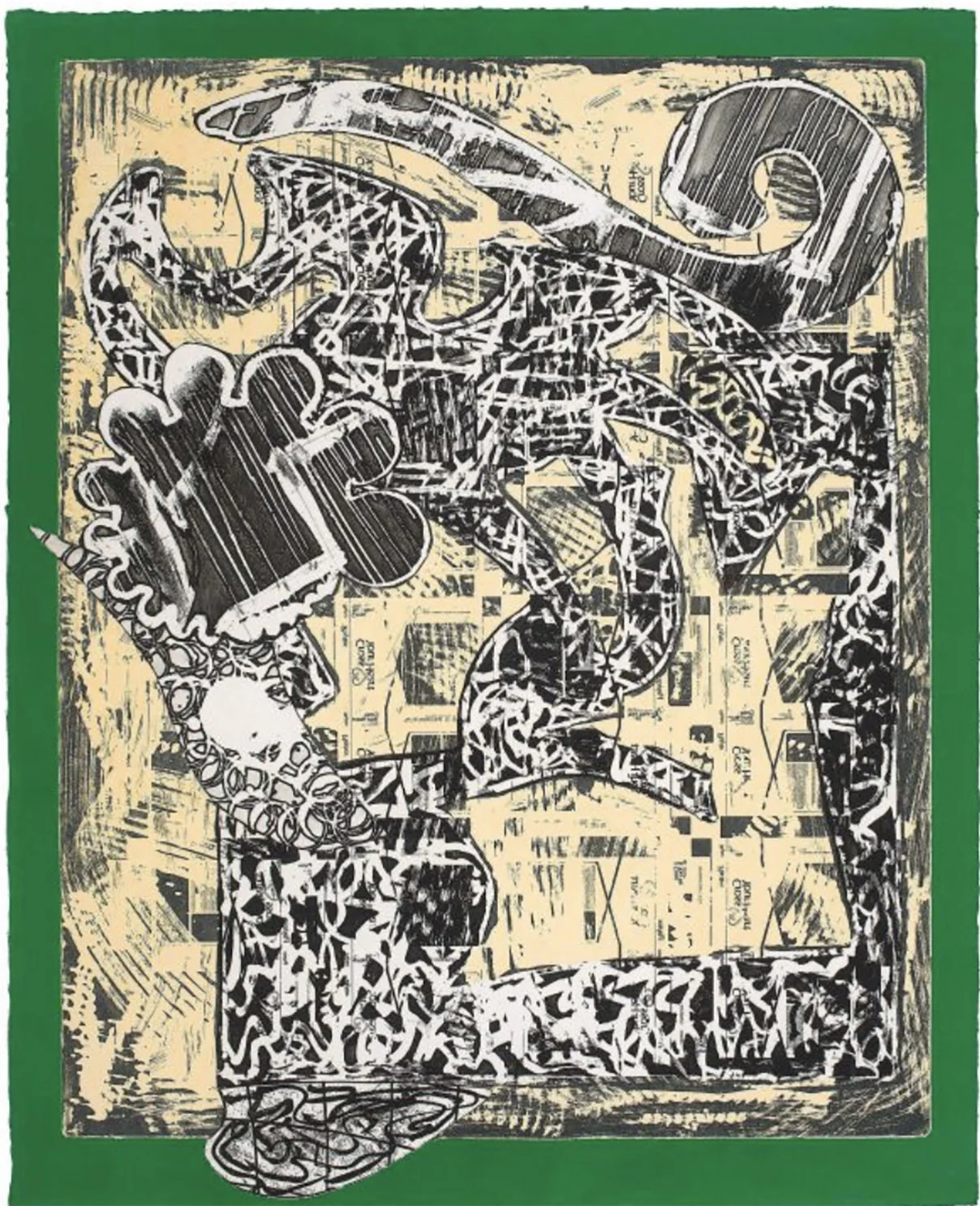
SOLD Green Journal, AP VI/X, 1985, Etching, screenprint, relief on white TGL handmade paper, 66 x 52 in.